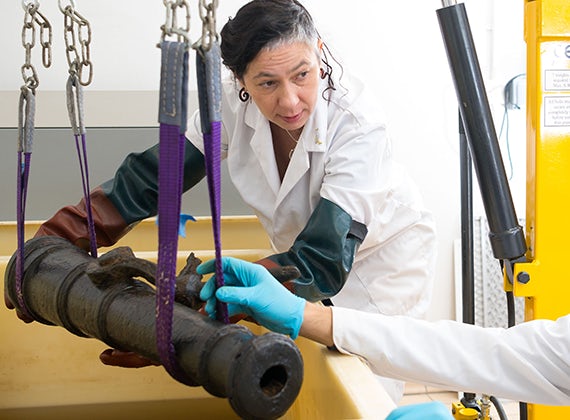
Prof David Watkinson
Publications – 2005-12 with abstracts
Rimmer, M., Watkinson D. and Wang Q. (2012) The efficiency of chloride extraction from archaeological iron objects using deoxygenated alkaline solutions. Studies in Conservation, 57, 29 - 41.
This study reports a quantitative assessment of aqueous deoxygenated alkaline washing solutions as chloride extractors from 120 individual archaeological iron nails. The three treatment methods comprised alkaline sulphite solution (0.1M NaOH /0.05M Na2SO3) at room temperature and 60°C and sodium hydroxide solution (0.1M) deoxygenated using a nitrogen-gas positive pressure system at room temperature. Chloride extraction was monitored using a specific ion meter. The nails were dissolved after treatment to measure their residual chloride content. A wide range of extraction patterns emerged, with the majority of individual treatments extracting between 65 - 99% of the chloride present. Residual chloride levels for 87% of the objects fell below 1000 ppm and 42% were below 400ppm. No treatment extracted 100% of the chloride but there were very significant reductions in chloride content. The impact of this on future corrosion is discussed. This quantitative and statistically viable assessment of deoxygenated washing treatments makes possible their evidence based application in conservation practice, which will impact on procedure for the preservation and management of archaeological heritage.
Malea E, Vogiatzi T and Watkinson D. (2012) Assessing the physical condition of waterlogged archaeological leather. Proceedings of the 11th ICOM-CC Group on Wet Organic Archaeological Materials Conference, Greenville 2010, eds. Kristiane Strætkvern & Emily Williams, Lulu.com USA, pp. 571-595.
The study determines the condition of waterlogged archaeological leather by a series of simple visual and physical examinations testing the flexibility, strength and coherency of the fibres. Fifteen waterlogged archaeological leather samples from Great Britain and Greece were examined under the SEM and also analysed recording; pH, shrinkage temperature (Ts), and amino acid analysis of collagen (HPLC). The results were statistically examined using Logistic Regression, Principal Component and Discriminant Analysis. The results revealed that analysing waterlogged archaeological leather statistically requires a more refined analytical approach and more samples.
Manti P, Henderson J, Watkinson D. (2011) Reflective practice in conservation education. ICOM Lisbon Conference. Preprints of the ICOM-CC 16th Triennial Conference, Lisbon, Portugal, September 19-23, 2011. The International Council of Museums – Committee for Conservation (ISBN 9789899752207)
Higher education should develop the core blueprint for the critical and reflective thinking that conservation professionals will employ and further develop during the remainder of their career. This paper defines and discusses reflective practice in conservation education using examples drawn from teaching and assessment methods in place at Cardiff University. Feedback reveals the challenges that students face in developing reflective thinking and the difficulty of offering evidence for this. The complex role of tutors in developing reflective thinking is identified. Reflective learning can significantly contribute to developing reflective and critical conservation practitioners.
Watkinson, D. (2010) Measuring the effectiveness of chloride extraction methods for corrosion control of heritage iron: problems and challenges. Corrosion Science Engineering and Technology, 45 (5), 400- 406.
The individual chloride content of 116 archaeological iron nails from Romano British and Medieval sites in Wales is reported. The meaning and value of chloride concentration recorded as weight of chloride in object/object weight (ppm) is discussed in relation to reporting the effectiveness of washing methods designed to remove chloride from archaeological iron. This is theoretically compared to the concentration value weight of chloride in object/metal surface area of object and the difficulty of quantitatively determining the success of washing methods as stability enhancers is discussed. It is concluded that assessing the impact of residual chloride on post-treatment corrosion of archaeological objects has the potential to offer the most significant guide to treatment success.
Parkes, P. and Watkinson, D. (2010) Computed tomography and x-radiography of a 21st/22nd dynasty coffin. In Decorated surfaces on Egyptian Objects: Technology, deterioration and conservation, Eds. Dawson, J., Rozeik, C. and Wright M., Proceedings of a conference held in Cambridge UK 7-8 September 2007. 58-66. Archetype
A 21st dynasty Egyptian polychrome wood coffin was subjected to visual examination, traditional x-radiography and computed tomography (CT). The data produced was compared and contrasted to provide an assessment for the commercial justification of employing CT scanning as part of a conservation programme.
Rimmer M and Watkinson D (2010) Residues of alkaline sulphite treatment and their effects on the corrosion of archaeological iron objects. In METAL 2010, Proceedings of the Interim Meeting of the ICOM-CC Metal Working Group, Charleston, South Carolina 11-15 October 2010, ed. P. Mardikian, C. Chemello, C. Watters and P. Hull, Clemson University (2011) 16-22. Available from www.lulu.com
Chemical residues introduced by alkaline sulphite desalination treatment of archaeological iron are believed to induce post-treatment corrosion. Evaporating solutions of ions expected to be present upon completion of this treatment showed FeSO4•4H2O/FeSO4•7H2O mixtures formed in the presence of sufficient Fe2+. In the absence of Fe2+ Na2SO4 formed. The influence of FeSO4 and Na2SO4 on the corrosion of iron was modelled at controlled temperature and relative humidity (RH). Hydration of Na2SO4 to Na2SO4•10H2O at 90% RH (20°C) corroded iron, while hydration of FeSO4•4H2O to FeSO4•7H2O at 75% RH resulted in barely detectable corrosion over a 10 day period. Stable RH below hydration transition points of 76.4% (20°C) for Na2SO4 and 60% (20°C) for FeSO4•4H2O did not significantly increase corrosion of iron. Examining the corrosion rate of a NaCl/FeSO4•7H2O/FeSO4•4H2O/Fe mixture revealed that Cl- offers a far more potent corrosion risk to iron than any residues from alkaline sulphite treatment.
Manti and Watkinson (2010) Hot tinning of low tin bronzes. In METAL 2010, Proceedings of the Interim Meeting of the ICOM-CC Metal Working Group, Charleston, South Carolina 11-15 October 2010, ed. P. Mardikian, C. Chemello, C. Watters and P. Hull, Clemson University (2011) 92-98. Available from www.lulu.com
Identification of hot-tinning on corroded bronze is often a challenging task due to the various mechanisms by which shiny or grey surface finishes can be formed. The nature of intermetallic compounds formed during hot-tinning changes during use because of solid state diffusion of copper, or due to application of heat at temperatures above the melting point of tin. To identify their presence, a clear understanding of tinning microstructures must be combined with knowledge of their forms relative to corrosion structures developed from general corrosion of the underlying bronze. This study reports on the examination and identification of the intermetallic phases associated with tinning. Reported experimental work is designed to examine aspects of the formation and detection of intermetallic compounds that can be used to discuss the challenges associated with definitive identification of tinning on low-tin bronzes.
Watkinson, D. (2010) Preservation of metallic cultural heritage. In: Richardson J. A. et. Al. (eds.) Shrier’s corrosion, volume 4, 3307-3340 Amsterdam: Elsevier.
The ethics and rationale that underpin the preservation of cultural metals are outlined and their influence on the conservation process is examined via a review of treatment strategies illustrated by example. Citing current and formative research into treatments illustrates the role of corrosion science in conservation and how it is continuing to develop and strengthen. Topics that merit further study and research are highlighted where appropriate.
Manti, P. and Watkinson, D. (2009) From Homer to Hoplite: Scientific Investigations of Greek Copper Alloy Helmets. In Science and Technology in Homeric Epics. Series: History of Mechanism and Machine Science, Preliminary entry 6. Paipetis, S. A. (ed.), Springer, ISBN: 978-1-4020-8783-7
Homer’s Iliad contains the earliest account of Greek armour technology, with heroes
such as Hector reported as wearing helmets that are flashing and shiny. Corrosion of helmets during their burial limits understanding of their original appearance in antiquity. Evidence of their original appearance is based mainly on interpretation of ancient literature and numerous artistic representations of helmeted warriors on pottery. Fragments from two archaic period helmets were analysed using SEM/EDX. One of the helmets was tin-plated and is one of the earliest recorded examples of tinning in the Mediterranean. This raises questions about the original appearance of Greek helmets, visibility of individuals on the battlefield and their status. A large scale investigation of Greek helmets is underway to address these points and examine the possibility that tinning in armour may go back to Homeric times.
Watkinson, D. and Lewis, M. R. T (2008) Desiccated storage of chloride contaminated iron: A study of the effects of loss of environmental control. In Heritage Microbiology and Science: Microbes, Monuments and Maritime Materials. May, E., Jones, M. and Mitchell, J. (eds), Special publication 315, Royal Society of Chemistry, Cambridge 279-89. ISBN978-0-85404-141-1
Controlling corrosion of iron by lowering humidity can be compromised by failure to maintain the target humidity to reduce or prevent the corrosion rate of iron. Iron powder mixed either with ferrous chloride or βFeOOH corrosion products was subjected to fluctuating relative humidity producing weight changes that recorded iron oxidation and hydration/dehydration phases. Failure to maintain the control relative humidity, even for short periods, resulted in oxidation of iron. βFeOOH was more significantly aggressive than ferrous chloride for the 15% to 30% relative humidity cycle, making it a dangerous post-excavation corrosion product.
Watkinson, D and Tanner, M. (2008) ss Great Britain: conservation and access – synergy and cost. In Conservation and Access; contributions to the London Congress 15-19 September 2008, Saunders, D., Townsend, J. and Woodcock, S. (eds), The International Institute for the Conservation of Historic and Artistic Works, London 109-114.
Conservation and access are integrated within a unique cutting edge desiccated storage design to preserve the iron hull of Brunel’s steamship ss Great Britain. As part of the visitor attraction conservation effectively contributes to its own costs. This synergy between the ship and its preservation programme enhances the visitor experience and increases visitor numbers. The ethical implication of choosing desiccation to preserve the ship is discussed and measures taken to mitigate its carbon footprint are reported. Comparative examples of energy expenditure offer insight into the relative cost of conservation in society.
Watkinson, D. and Al Zahrani, A. (2008) Towards quantified assessment of aqueous chloride extraction methods for archaeological iron; de-oxygenated treatment environment. The Conservator 31, 75-86.
Alkaline sulphite; de-aerated sodium hydroxide; de-aerated Soxhlet; de-aerated water; sodium sulphite and aerated water washing methods for chloride extraction from archaeological iron are quantitatively compared using experiments which also examine active variables within the mode of treatment. De-aeration and alkali had the best and most consistently predictable chloride extraction efficiencies. This is attributed to prevention of corrosion during treatment and the action of alkali. Treatments that allowed iron to corrode were poor chloride extractors. Results suggest that washing treatments can significantly lower the chloride content of iron.
Watkinson, D. and Lewis, M. (2008) ss Great Britain: Science and technology underpin enclosure design. Conservation Matters in Wales, On Display: Showcases and Enclosures, Henderson J. (ed). Federation of Museums and Art Galleries in Wales, 13-17
The paper offers an overview of the ss Great Britain preservation programme from 2000 to 2008. The problems associated with the preservation of the ss Great Britain are identified and the production of scientific evidence to support the design of a desiccation system is reported.
Taylor, J. and Watkinson, D. (2007) Indexing Reliability for condition survey data, The Conservator, 30 49-62
This paper discusses the application of existing indices for measuring reliability to collection condition survey data. The essential requirement of reliability is understood by conservators but has never been quantified. The relatively recent introduction of computer methods that calculate reliability is mentioned as a significant step towards introducing the practice of ensuring reliability during pilot studies. The paper discusses different methods of quantification, and their qualities, as well as the aims of assessing reliability for condition surveys. The most satisfactory index for conservation applications, and choosing an appropriate level of reliability are suggested. However, no single number is offered as a standard. It is recommended that more than one index should be used. The aper also describes techniques to use indices to determine causes of disagreement, so reliability can be increased.
Weber L., Eggert, G. and Watkinson D. (2007) A closer look at brown staining on archaeological glass, Glass and ceramics conservation 2007, Pilosi, L. (ed.), Interim Meeting of the ICOM-CC working Group, 27-30th August 2007 Nova Gorica, Slovenia Goriski Muzej, 35-45.
The role of manganese compounds in the staining of archaeological glass is reviewed. Faces and cross sections of several sherds of brown stained medieval archaeological glass are analysed using scanning electron microscopy, energy dispersive X-ray analysis (SEM-EDX), stereomicroscopy and light-optical microscopy. This reveals that elements and materials other than manganese compounds are associated with staining. Chief amongst these is iron. A catalogue of staining phenomena with corresponding analytical data is provided
Manti, P. and Watkinson, D. (2007) Examination of Greek Bronze Helmets; sampling and project design, Metal 07: When Archaeometry and Conservation Meet, Amsterdam 17-22 September 2007, Rijksmuseum Amsterdam, Book 1, 78-82.
Difficulties met when requesting invasive sampling of museum objects are described and strategies for successful applications are offered. The paper focuses on experiences during sample collection for a project to analyse early Greek copper alloy helmets. This project will examine in a later stage, helmet compositions and surface coatings then link this to original appearance and manufacturing technologies.
Watkinson, D. and Corfield, M. (2007) Preservation and protection of archaeological sites. Encyclopaedia entry for Encyclopaedia of Archaeology, Elsevier.
The chapter reviews the main variables and factors to consider when addressing the conservation and preservation of archaeological sites.
Watkinson D. (2006) Ethical challenges in the conservation of cultural material, Ethics, law and society, Volume 2, Gunning J and Holm S, (eds.), 95-108, Ashgate, Aldershot UK.
The ethical challenges facing conservation practitioners are illustrated by example. Discussion evolves around situation ethics and how there can often be multiple ethical options and each has a valid supporting argument.
Pavlopoulou, L. and Watkinson, D. (2006) The degradation of oil painted copper surfaces, Reviews in Conservation, 7 55-66
Degradation of oil painted copper surfaces involves chemical, physical and mechanical processes that are influenced by the prevailing environment. The oil paint/copper interface determines the stability of the system. The components of the painted copper and their interactions are identified and discussed. Ingress of water and ions to the oil paint/copper boundary through paint film defects promotes electrochemical reactions at the metal surface, which lead to adhesion loss. Destabilisation begins with bond failure and blistering, which provides ideal conditions for the initiation of delamination. The study reveals that further work on the structure and properties of copper carboxylates of individual and mixed linseed oil fatty acids, together with models of their reaction, would further understanding in the field.
Watkinson, D., Tanner, M., Turner R. and Lewis M. (2005) ss Great Britain: teamwork as a platform for innovative conservation, The Conservator, 29 73-86.
Brunel’s ss 1843 Great Britain was a technological milestone of world importance. It now rests in its original dry dock in Bristol. Research established the significance of the ship, identified its inherent instability and reviewed conservation options to support a successful 8.5 million pound Heritage Lottery Fund bid. The complex preservation project involved innovative use of desiccation to preserve the hull, along with a large scale conservation programme for the fabric of the ship and dockyard structures. The input of architects, engineers, conservators, corrosion scientists, historians and many other specialists was managed directly by the executive director and a qualified project manger who maintained timetables and co-ordination. Research into the effect of relative humidity on the corrosion of chloride infested iron provided data for use in a design that changed the dry dock into a climatically controlled envelope around the unstable hull.
Watkinson D. and Lewis M. (2005) Desiccated storage of chloride contaminated archaeological iron objects. Studies in Conservation, 50 241-252.
Desiccation has long been used to store chloride-contaminated archaeological iron but there are no precise guidelines on the degree of desiccation required to prevent corrosion occurring. Akaganéite (β-FeOOH, ferrous chloride tetra-hydrate (FeCl2•4H2O) and ferrous chloride di-hydrate (FeCl2•2H2O) have been recorded on archaeological iron. Iron corrodes in the presence of FeCl2•4H2O and β-FeOOH but not in the presence of FeCl2•2H2O. The rate of desiccation of FeCl2•4H2O at various levels of relative humidity (RH) was determined by experiment and found to be an exponential relationship. The point at which FeCl2•2H2O first becomes a stable hydrate was established. Rates of corrosion for iron mixed with FeCl2•4H2O and with β-FeOOH were examined for a range of RH. The hygroscopicity of β-FeOOH and the RH at which it ceases to cause iron to corrode were established. Corrosion of iron in contact with FeCl2•4H2O and β-FeOOH speeds up as RH rises and is appreciable at 25% RH and above. On the basis of these results, recommendations are made that 12% should be the maximum allowable RH for long-term storage of archaeological iron from chloride-bearing soils. Low RH requirements raise problems for long-term monitoring
Watkinson D., Weber L., and Anheuser K. (2005) Staining of archaeological glass from manganese rich environments. Archaeometry, 47 67-80.
It has been suggested that both internal and external sources of manganese may produce the black or brown staining that often occurs in buried archaeological glass. Modern potash glass of a manganese-free medieval composition was scratched, etched and immersed in an aqueous solution containing dissolved manganese. After several weeks immersion samples were sectioned and examined by SEM EDX. Manganese was shown to be present in fissures and cracks within in the glass, where it is beginning to form the characteristic dendrite-like patterns seen in buried archaeological glass. Manganese from an external source is capable of blackening buried medieval potash glass.
Watkinson D. and Lewis M.R.T. ( 2005) The Role of βFeOOH in the Corrosion of Archaeological Iron, in Materials Issues in Art and Archaeology VII, Vandiver P.B., L. Mass J.L., and Murray A. (eds.), Material Research Society Symposium Proceedings 852, Warrendale, PA, 2005, 001.6.
The chloride bearing corrosion product akaganéite (βFeOOH) can form during post-excavation corrosion of chloride infested archaeological iron and is able to corrode iron in contact with it. Its action on iron is examined using βFeOOH synthesized from ferrous chloride and iron powder. Using weight measurements the hygroscopicity of βFeOOH is established. The influence of relative humidity on the corrosion of iron powder mixed with βFeOOH is examined by dynamic weight change within a climatic chamber. At 20oC and 12% relative humidity, iron in contact with βFeOOH did not corrode. At 15% relative humidity slight iron corrosion was detected after 160 hours but at 35% relative humidity rapid corrosion was recorded after a few hours. Surface adsorbed chloride was removed from βFeOOH by aqueous washing and this reduced its hygroscopicity. The reported metastability ofβFeOOH was examined via xrd of a 23 year old sample, which was found to be still entirely composed of βFeOOH. These results provide better understanding of βFeOOH corrosion of iron, corrosion control of chloride infested iron using dry storage and the effect of aqueous washing on archaeological iron.
Watkinson D. and Lewis M. (2004) ss Great Britain iron hull: modelling corrosion to define storage relative humidity, Metal 04 Proceedings of the international conference on Metals Conservation, Ashton J. and Hallam D. (eds.), Canberra Australia 4-8 October 2004, 88-103 National Museum of Australia.
The chloride containing hull of Brunel’s wrought iron ship ss Great Britain is corroding in its dry dock in Bristol. Corrosion control will involve sealing the dock and desiccating it. While it is corroding the iron hull forms chloride rich bFeOOH. During desiccation ferrous chloride is likely to form. Both these compounds are known to corrode iron. bFeOOH and FeCl 2.4H 2O were subjected to controlled relative humidity (±1%) and mixed with iron powder. Corrosion of iron depended on the relative humidity value. Corrosion thresholds for bFeOOH /iron and FeCl 2.4H 2O/iron mixtures were experimentally determined. Iron in contact with these compounds corroded above but not below these values. Iron did not to corrode in the presence of FeCl 2.2H 2O. The stability of this compound to moisture was determined. Slightly above corrosion thresholds corrosion was extremely slow. It increased significantly as values rose to 30%. The results are being used to set an operational relative humidity for the desiccated environment around the ss Great Britain. Extrapolation of these results to different contexts offers new conservation options for other historic ships.
Other Publications
Taylor J and Watkinson D., (2003) Using Multiple Hypotheses in Collections Condition, The Conservator, 27 13-22.
Watkinson, D. E. (2001) Maximising the life-span of archaeological objects. Handbook of Archaeological Sciences, Brothwell D. and Pollard A. M. (eds.) 649-660, Wiley London
Gneisinger W. and Watkinson D.E. (2000) Innovative Uses for Aqueous Foams in Conservation Practice, Tradition and Innovation: Advances in Conservation, Roy A. and Smith P. (eds.), IIC 18 th International Congress – Melbourne 2000, 77 – 81 IIC London
Malea, E and Watkinson, D. E. (1999) Contribution of Analytical Methods in the Estimation of the Condition of Waterlogged Archaeological Leather, Methods in the Analysis of Deterioration of Collagen based Historical Materials in relation to Conservation and Storage, European Commission Directorate-General XII Environment and Climate Programme, Copenhagen, 249-60, Royal Danish Academy of Fine Arts.
Loukopoulou, P. and Watkinson, D. E. (1999) Protective Effects of Paint Layers on the Surface of Painted Archaeological Window Glass, ICOM – Conservation Committee 12 th Triennial Meeting – Lyons, 782-86, James and James, London.
Watkinson, D. E. and Neal, V. (1998) First Aid for Finds. 3 rd edition. 108 pages, RESCUE and UKIC.
Malea, E., Stassinou, A., Lilikogou, V., Ionnidis, I. A. and Watkinson, D. (1997) Preliminary report on the examination of leather book bindings belonging to the national library of Athens, Postprints of the 4 th Interim Meeting of the ICOM Committee for Conservation Working Group on Conservation of Leather and Related Objects, Amsterdam 5 th-8 th April 1995, 50-6.
Earl N. J. and Watkinson D. E. (1997) Assessment of Post-Excavation systems for archaeological glass using FT-IR Microscope, Archaeological Sciences 1995, Sinclair A., Slater E. and Gowlett J. (eds.), Proceedings of a Conference on the Application of Scientific Techniques to the study of Archaeology, 19-30 Oxbow Books. Oxford.
Watkinson, D. E. and Stevenson, S. (1996) Assessing Student Practical Work, ICOM Committee for Conservation 11th Triennial, Bridgeland, J. (ed.), Edinburgh 1-6 September 1996, 145 -51, James and James, London.
Watkinson, D.E. (1996) Chloride extraction from Archaeological Iron: Comparative Treatment Efficiency, Archaeological Conservation and its Consequences, Roy A. and Smith P. (eds.), 208 – 212, International Institute for Conservation, London.
Watkinson D. E. (1996) Defining the contribution of non-conservators to conservation: the role of the conservation technician, A Qualified Community: Towards Internationally Agreed Standards of Qualification for Conservation, Cronyn J. and Foley K. (eds.), ICOM Working Group on Training and Restoration - Interim Meeting: Maastrict 6-8 April 1995, 14 - 18.
Watkinson, D.E. and Brown, J.P. (1996) The Conservation of the Polychrome Wood Sarcophagus of Praise Mut, Conservation in Ancient Egyptian Collections, Brown C., McAllister F. and Wright M. (eds.), 37 – 46, Archetype Publications.
Watkinson, D. E. (1995) Teaching Conservation: Educational Changes and Syllabus Congestion. Quelle Restauration. Table Ronde sur La Formation Professionnelle du Conservateur-Restauratur D'Ouvres D'Art in Europe. Centro Regionale di Catalogazione e Restauro dei Beni Cultrali. 71 – 78
Watkinson, D. E. (1995) Review of Handbook of Field Conservation by Helge Brinch Madsen, Studies in Conservation, 40 214 - 215.
Gillard, R.D., Hardman, S., Thomas, R. and Watkinson, D. E. (1994) The mineralisation of fibres in burial environments, Studies in Conservation, 39 132 - 140.
Gillard, R.D., Hardman, S., Thomas, R. and Watkinson, D. E. (1994) The detection of dyes by FT - IR microscopy, Studies in Conservation, 39 187 - 192.
Gillard, R.D., Hardman, S., Watkinson, D. E. (1993) Recent advances in textile studies using FT-IR microscope, Conservation Science in the UK , Tennant, N. (ed.), 71 - 76 James and James, London.
Watkinson, D.E. (1994) A Note on the Conservation of the 18th Century Rederos in Parkinson A. J. Paintings and Inscriptons in Penant Melangel Church. The Montgomeryshire Collections, Journal of the Powysland Club, 82 139-146.
Watkinson, D.E. (1994) A textile pin cushion in Medieval and Later Usk 1965 – 76, Courtney P. (ed.), 95 -6.
Watkinson, D.E. (1993) Review of Retrieval of Objects from Archaeological Sites, Payton R. (ed.) in Conservation News, 51 20 – 23, United Kingdom Institute for Conservation.
Earl, N. and Watkinson, D. (1993) The examination of archaeological enamel using FTIR microscope, Glass Technology, 34 no. 2, 69-70.
Earl-Turner, N. J. and Watkinson, D.E. (1993) Use of FT-IR microscopy to assess the relative efficiency of various storage environments for waterlogged archaeological glass, Conservation Science in the UK. Tennant, N. (ed.), 77- 84. James and James, London.
Watkinson, D. E. (1993) Conservators and conservation technicians: definitions and differences. ICOM 10th Triennial Preprints Washington , Bridgland J. (ed.), 750 – 758, James and James, London.
Watkinson, D. (1992) Conservation and University Education, Conservation Training and Employment, United Kingdom Institute for Conservation Occasional Paper 12, 6-10
Lange, E. and Watkinson, D. (1992) Image processing and its application to x-radiography, Conservation News, 47 38 - 41.
Cameron, E., Watkins, S. and Watkinson, D. (1988) Provision for Archaeological Conservation in England and Wales: A review, United Kingdom Institute for Conservation, 40 pages.
Watkinson, D, (1988) Materials for Conservation, Book review for Studies in Conservation, 33 160-1.
Starling, K. and Watkinson, D. (eds.) (1987) Bone Horn Antler and Ivory, United Kingdom Institute for Conservation, Occasional Paper, 36 pages.
Leigh, D. and Watkinson, D. (1986) Conservation in Welsh Museums and Galleries, 82 pages, University College Cardiff.
Watkinson, D. (1983) Degree of mineralisation: Its significance for the stability and treatment of excavated ironwork, Studies in Conservation, 29 85-90.
Watkinson, D., (1982) Making a large scale replica: The Pillar of Eliseg. The Conservator, 6 6-11.
Watkinson, D. (1982) An assessment of the lithium and sodium hydroxide treatment methods for archaeological ironwork, Conservation of Iron, Clark R. and Blackshaw S. (eds.) National Maritime Museum Monograph, 53 28 – 40, National Maritime Museum.
Watkinson, D. (1979) Lithium Hydroxide: An interim report, The Conservation and Restoration of Metals, Scottish Society for Conservation and Restoration, 24-32, Edinburgh.
D. Leigh and Watkinson, D., (1978) Note on the toxicity of isocyanates, Conservation News, United Kingdom Institute for Conservation.