Professional Conservation (MSc)

What is involved in the MSc Professional Conservation?
Cardiff's Professional Conservation MSc provides opportunities for qualified conservators and scientists to develop their primary training in professional conservation practice and to enhance their research skills. The MSc Professional Conservation is designed primarily for trained conservators. Thus, the Cardiff degree is different from other conservation masters schemes which are conversion courses aimed at students with non-conservation undergraduate degrees. Alternatively, the MSc also provides science graduates with the opportunity to utilise their training and to develop their specific research skills within conservation science.
The design of the degree allows the programme to satisfy both types of applicants. Core skills training is linked to a range of specialised option modules, which fine-tune the degree towards conservation or conservation science. Using seminar-style teaching, the degree delivers important transferable skills, including communication techniques, public address and critical assessment, research report and essay writing; all are planned with the needs of the workplace in mind.
The Professional Conservation MSc is not a practical vocational training in conservation; if you are interested in acquiring such training, you should consider applying for Cardiff's MSc in Conservation Practice or the BSc in Conservation.
Our approach to teaching and learning
With the support of the teaching staff, MSc students take an active role in the learning process. Successful teaching at postgraduate level requires independent action from students as they develop their own ideas and communicate their thoughts and questions to staff and to peers. The resulting dialogue focuses on the issues in question, avoiding one-way exchange, the hallmark of outdated lecturing techniques. Teaching and assessment are based on verbal communication, discussion groups, reports and essays, as well as an in-depth dissertation. Cardiff's interactive approach to teaching demands that we limit the number of students we admit to the degree in any one year but allows us to work intensively with small groups of students.
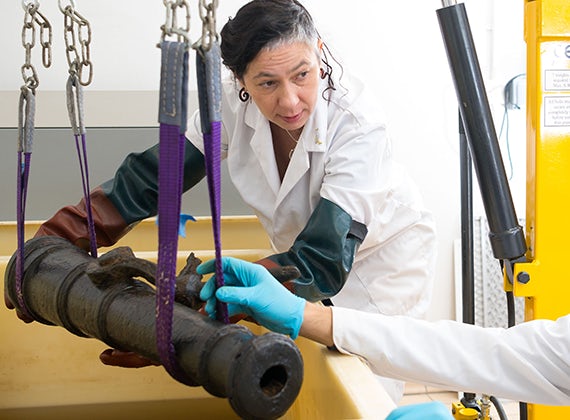
MSc students are often involved in practical work investigating and analysing archaeological and historic artefacts, either within the particular modules they take or as a basis for their dissertation. Provided that the aims and objectives of object-based work are linked to those of the MSc and provided that the student has appropriate, prior conservation training and skills, then a dissertation project can include the practical conservation of an object.
Watch a video about the Conservation degree programmes and facilities at Cardiff University.
How is the course structured?
The MSc Professional Conservation runs for twelve months, beginning at the end of September. The programme is divided into two parts. Part one is assessed by coursework and examinations, which are collated at the end of the second semester of the academic year. Students must pass the first part in order to progress to the second, which is purely a research element and which takes the form of a dissertation of up to 20,0000 words.
Students who have a BSc in Conservation or an equivalent qualification take the following 180 credits of modules. Students who have an undergraduate degree in science or applied science cannot take HST320 Theory and Practice in the Workplace.
Please note that some modules are subject to review and may change prior to academic year 2013-2014.
Skills modules (40 credits)
- Writing Archaeology - 10 credits (HST300)
- Research Methods - 10 credits (HST301)
- Speaking Archaeology - 10 credits (HST302)
Conservation modules (80 credits chosen from the following list)
Dissertation (60 credits)
What will I learn and what skills will I acquire?
The Professional Conservation MSc offers students the chance to acquire and perfect valuable transferable skills critical to careers in many different fields. Upon completion of the programme, students will have acquired the following skills:
Intellectual skills, including the ability to critically evaluate evidence and its interpretation and to be tolerant of differing interpretations; to sustain a logical argument and reach a conclusion that can be defended; to synthesise and analyse information; to compare and contrast theoretical explanations and to integrate different methodologies.
Communication skills, including the ability to communicate orally in an appropriate professional medium; to make presentations both as an individual and as part of a group; to write effectively at an advanced level.
Numeracy skills, including the ability to display and present numerical data in appropriate formats; and to analyse numerical data and solve basic mathematical and statistical problems.
Information technology skills, including the ability to produce and calculate values using a spreadsheet; to produce and query databases; to use e-mail, the Internet and the World Wide Web; to find, manage and utilise information and data.
Personal skills, including the ability to manage workloads; to adapt and apply skills to new contexts; to assess and formulate priorities, constraints and goals and to adapt to changing circumstances.
Above all, by the end of the Cardiff Masters degree, students will be able to critically assess the work of others and of their own, to engage effectively in debate at an advanced level, to plan, design and carry out a coherent research strategy, and to produce detailed and coherent reports and presentations.
Funding
To find out about funding opportunities, please visit our Postgraduate Funding Opportunities page.
Admissions requirements
Students applying to take the MSc should have (normally) one of the following qualifications:
- At least an Upper Second Class (2.i) undergraduate degree in Conservation or a related subject.
- Experience, qualifications or achievements in museums, heritage management or another field of relevance. Potential applicants are required to contact the postgraduate admissions tutor
- For overseas students, the minimum requirements for English language are IELTS 6.5 or TOEFL 600 (paper-based test) or 250 (computer based test).
We encourage applications from students whose undergraduate degrees are from non-UK universities. Please contact the postgraduate admissions tutor to discuss particular requirements.
For more information contact:
Admissions Tutor for Postgraduate Conservation
See this course on the University's Coursefinder website.