Conservation Practice (MSc)
The MSc in Conservation Practice offers opportunities for graduates to train to become professional conservators equipped to operate in the museum and heritage sector. Alternatively, it can prepare graduates for further research and offers transferable skills in project and resource management, problem-solving and communication for a wide range of careers.

What will I learn on the MSc?
The programme aims to provide a conservation qualification that encompasses both theoretical and practical skills. It provides a comprehensive intellectual framework with which to interpret, synthesise and critically evaluate objects and collections, using evidence from research and from written sources. Students develop a detailed understanding and critical appreciation of conservation theory and practice via project management and conservation of objects. Students learn how to conserve objects from museums, archaeological sites, historic houses, churches and other cultural heritage collections.
How is the course structured?
The MSc in Conservation Practice is a two-year Masters programme. The first year is taught alongside undergraduate teaching, and covers the underpinning skills and knowledge of conservation. The second year is taught entirely at Masters level and shares its structure with other Masters programmes. The second year incorporates a taught element which lasts for the first two semesters of study and is assessed at the end of this period; this is followed by a dissertation. In the summer between the two years there will be an eight-week placement working in a conservation laboratory or related department for a museum, archive, conservation unit, heritage site or private conservation studio.

Our approach to teaching and learning
With the support of the teaching staff, MSc students take an active role in the learning process. Successful teaching at postgraduate level requires independent action from students as they develop their own ideas and communicate their thoughts and questions to staff and to peers. The resulting dialogue focuses on the issues in question, avoiding one-way exchange, the hallmark of outdated lecturing techniques. Teaching and assessment are based on verbal communication, discussion groups, reports and essays, as well as an in-depth dissertation. Cardiff's interactive approach to teaching demands that we limit the number of students we admit to the degree in any one year but allows us to work intensively with small groups of students.
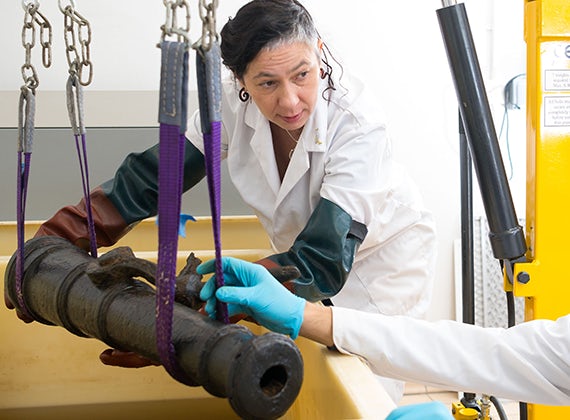
MSc students are often involved in practical work investigating and analysing archaeological and historic artefacts, either within the particular modules they take or as a basis for their dissertation. Provided that the aims and objectives of object-based work are linked to those of the MSc and provided that the student has appropriate, prior conservation training and skills, then a dissertation project can include the practical conservation of an object.
Watch a video about the Conservation degree programmes and facilities at Cardiff University.
Admissions requirements
- If you have an upper second class Honours degree (or equivalent) from a British or recognised overseas university in archaeology, history, ancient history, conservation, science, chemistry, biology, physics, geology, or other related and relevant disciplines in the humanities, social sciences and biological and physical sciences, then you will be eligible for the course. We encourage applications from students whose degrees are from non-UK Universities. Please contact our admissions tutor to discuss particular requirements.
- The course contains a strong science element so you will be required to have evidence of scientific ability: for example, an A level in chemistry or strong science profile at GCSE, or broad spectrum qualifications which include science such as the international baccalaureate.
- For overseas students, the minimum requirements for English language are IELTS 6.5 or TOEFL 600 (paper-based test) or 250 (computer based test).
- Exceptionally, candidates with an existing relevant degree in conservation could be considered for the programme.
If you would like to discuss your qualifications, please contact our admissions tutor for postgraduate conservation:
What modules will I take?
Please note that some modules are subject to review and may change prior to academic year 2013-2014.
In Year One all students take four compulsory training modules:
- Practical Projects 2 - 40 credits (HS2331)
Plus, for those students commencing the programme in even years:
Or, for those students commencing the programme in odd years:
The second year is split between the taught element (autumn and spring) and the dissertation, which you complete over the summer.
All students will study two larger modules to develop advanced conservation knowledge and skills:
and four core transferable skills modules:
- Writing Archaeology - 10 credits (HST300)
- Research Methods - 10 credits (HST301)
- Speaking Archaeology - 10 credits (HST302)
Second Year Dissertation (summer): Upon successful completion of their coursework, all students write a dissertation (maximum length 20,000 words) on a conservation-related topic. This may be theory, practice or research-based: students are encouraged to focus their work on a real-life problem.
Funding
To find out about funding opportunities please visit our Postgraduate Funding Opportunities page
What are the fees?
For details of our current fee structures please visit the the Cardiff University Postgraduate Tuition Fees page and/or the Cardiff University Course Finder page link for this module given below.
See this course on the University's Coursefinder website.